
Relax. This is not becoming a political blog. But the government named them Trump Accounts, and I do not make the rules, I just explain them. So let’s refer to them from here on by their section of the tax code: 530A accounts.
Here is my take up front: 530A accounts are an interesting new source of optionality for your kids. There are specific situations where they make sense, and others where they do not. Which one you are in depends on who you are, so this article is organized that way.
THE TL;DR
- The $1,000 federal seed is free money. Child born 2025 to 2028? Open the account, take it. Left completely alone, that single deposit is roughly $81,000 when they retire.†
- If your minor has earned income, a Roth IRA beats everything in this newsletter. And the two accounts do not share a limit, so a working minor can have both.
- Older kids may have free money waiting too. The Dells’ $6.25 billion pledge, among others, is putting $250 into the accounts of kids 10 and under who live in ZIP codes where the median family income is $150,000 or less. Before you assume that is not you: the screen looks at the whole neighborhood, so places like Los Feliz, Silver Lake, and Toluca Lake clear it. Check your ZIP in thirty seconds at investamerica.org/dell. The account has to exist to receive the money.
- Should I contribute $5,000 a year? These are traditional IRAs funded with after tax dollars, and the wrapper only pays off if your family executes a well timed Roth conversion in your kid’s low income years, roughly 20 years from now. (You need to be aware of the kiddie tax when you do, more on that below.)
- Saving for college? Fund your 529 first. Then, if the plan shifts or you start to feel overfunded, divert the overflow here as a hedge on a future where the college paradigm itself may be changing.
- For families just starting to invest, a 530A is the easiest on-ramp that has ever existed.
†Hypothetical illustration assuming a constant 7% annual return with no fees, taxes, or withdrawals. Actual results will vary.
What is a 530A? The 60-second version
- A 530A acts like a Roth when money goes in and a traditional IRA when money comes out: contributions get no upfront tax deduction, and withdrawals are taxed as ordinary income. In effect, it allows tax deferred growth without giving you a tax benefit on the way in or the way out. That distinction drives everything below.
- Kids born 2025 to 2028 get a one time $1,000 federal seed deposit when the account is opened.
- Anyone can contribute up to $5,000 per year total, of which an employer can add up to $2,500 (per employee, not per child). Your own contributions go in after tax; employer dollars go in tax free, which matters later because they carry no basis. The $1,000 seed does not count against the cap, and it goes in with zero basis, meaning the seed itself, not just its growth, will be taxed when it is later withdrawn.
- Money is locked until January 1 of the year your child turns 18, at which point it operates as their traditional IRA. It was their asset all along; at 18, the control is theirs too.
- After 18, withdrawn funds (not including basis) are taxed as ordinary income, and standard IRA early withdrawal rules apply: pull money out before age 59½, and there is generally a 10% penalty on top of the tax, with carve outs for things like qualified education costs and a first home purchase (up to $10,000).
- For now the money sits in a low cost, broad U.S. stock index fund, with an S&P 500 fund as the launch default and fund fees capped at 0.1%. A wider menu is expected to open up over time. You open and manage it through an app, so there is almost no friction to getting started.
For the full feature rundown, the Wall Street Journal has a good explainer, and trumpaccounts.gov is the official source. Those cover the what. My job here is the so what.
Part one: the free money (not a judgment call)
If your child was born between 2025 and 2028: open the account, file the one page Form 4547, pass Go, collect your $1,000.
That is it. That is the analysis. Bottom line, taking a free $1,000 that compounds for six decades is the right move. The same goes for employer contributions; a growing list of large companies has said they will match the government’s deposit or contribute for employees’ kids. If yours is one of them, take it.
One part that has not received enough attention: the free money is not just for babies. The law lets charities, states, and local governments make qualified general contributions to every child in a defined group, and those deposits do not count against the $5,000 annual cap. The Dell Foundation has pledged $6.25 billion to put $250 into the account of every child aged 10 and under who lives in a qualifying ZIP code and did not get the federal $1,000. In other words, it is aimed squarely at the 2016 to 2024 kids the government skipped. Others are piling on: the Dalios are adding $250 for Connecticut kids, Brad Gerstner is funding $250 for every Indiana child under 5, Oklahoma has authorized a statewide version, and companies like Micron are seeding accounts in the counties where they operate and matching employee contributions.
Now for the eligibility screen, because the details matter. The Dell gift goes to ZIP codes where the median family income is $150,000 or less, measured across the whole neighborhood using Census data, not your household’s own income. Remember what a median is: it counts every renter, every duplex, every studio apartment on the block, not just the houses in the hills. So the threshold reaches further than people expect. Plenty of LA neighborhoods clear it, Los Feliz, Silver Lake, Toluca Lake, Valley Village, the Laurel Canyon flats, and the Encino flats among them, with Mar Vista sitting just under. But it can turn on the ZIP: one Santa Monica ZIP (90404) clears the bar while the rest of the city does not.
The good news is you do not have to guess. Invest America, the nonprofit behind the program, runs an official checker at investamerica.org/dell: enter a birth year and ZIP and it tells you on the spot. Stick to that one, or trumpaccounts.gov itself. A crop of third party eligibility checker sites has sprung up, some harvesting emails and Social Security numbers, so any site asking for personal details before answering a simple ZIP question is a site to close. Thirty seconds of checking is worth $250 per kid, and it is first come: the gift is capped at the first 25 million activated accounts, so this is one of the rare cases where opening the account today beats opening it next year.
Either way, the account has to exist to catch any of this: it costs nothing to open, and it is the bucket every future charitable, state, or employer dollar needs a place to land in.
Part two: your money (four scenarios)
The $1,000 is free. The $5,000 you put in yourself is a different question, and the answer depends on which of four scenarios you are in.
Scenario 1: You have already maxed everything else
The pitch you will hear is one more tax advantaged bucket. Half true. Remember, this is a traditional IRA funded with after tax dollars. No deduction going in, ordinary income tax on the growth coming out. On its own, that is a mediocre trade for a family whose alternative is a plain index fund taxed at capital gains rates.
What rescues it is a play that runs two decades from now: once the account becomes your kid’s traditional IRA, it can be converted to a Roth. Your contributions come out as tax free basis; only the growth, the seed, and any employer dollars are taxed. Convert during your kid’s low income years and you have manufactured a Roth IRA with an 18 year head start, something no other account lets a child without earned income do.
The snag almost everyone will hit: the kiddie tax. Conversion income is unearned income, and through age 23 a full time student whose wages do not cover half their own support has unearned income taxed at the parents’ rate. Convert while your kid is a sophomore and you have just taxed two decades of growth at your top bracket. The real window opens after the kiddie tax ages out and before their career income ramps up, which for an ambitious kid might be two years wide. Someone also has to track basis on Form 8606 for twenty years and fund the tax bill on conversion, because paying it from the account itself, as Scenario 4 shows, comes at a steep cost.
So my honest Scenario 1 verdict: this is less of a strategy question, and more of a follow through question. The wrapper only beats a taxable account if your family executes the last step: a well timed conversion, done by a 24 year old, in roughly 2048. This is my plan, but you need to decide now whether you are that family.
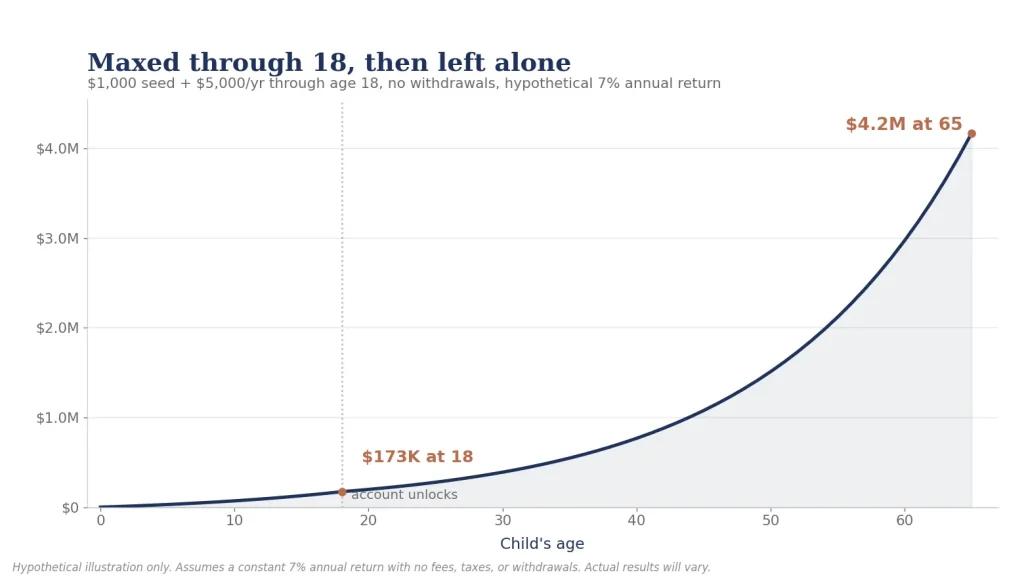
Maxed through 18, then left alone. One caution on reading this: because the account is still a traditional IRA here, that $4.2 million is a pre tax balance. Withdrawn in retirement, it is taxed as ordinary income. The conversion play is how you turn the same balance into tax free money, which is the Scenario 4 picture below.
Scenario 2: You are saving for college
Education planning means juggling four things at once: what your family can afford, what your kid wants to do, what makes financial sense, and, increasingly, whether the degree still pays for itself. You are doing this before your kid has developed motor skills, let alone executive functioning.
The stakes: the average private college runs about $65,000 a year today, roughly $262,000 for four years, with elite schools already past $90,000 a year. Project that forward 18 years at the historical 4 to 5% annual increase, and a child born today could face $550,000 to $680,000 for four years at an average private school, and well past $800,000 at an elite one.‡
‡ College cost figures are straight line projections of current published sticker prices at an assumed 4 to 5% annual increase, before financial aid. Actual cost varies.
My framework: decide what you believe about college, then fund your 529 to that number before a 530A gets a dollar. The 529 remains the better education vehicle, and it just got better: the 2025 law raised K-12 qualified expenses to $20,000 a year, added trade credentials and apprenticeships, and let leftover funds roll to a Roth IRA or another beneficiary.
Read the fine print on that Roth rollover, though: $35,000 lifetime per kid, capped at the annual IRA limit (about $7,500 a year, so five years to move it all), only after the 529 has been open 15 years, and your kid needs earned income each year to receive it. It is a relief valve, not a trapdoor, and it is exactly where the 530A fits in: no education strings, no rollover cap, no earned income requirement, and its own path to a Roth through conversion. The 529 is the better tool for the plan. The 530A is the better tool for the plan changing.
I am also less certain than I have ever been that the paradigm I grew up with, where the college pedigree was the whole game, survives the next fifteen years intact. The cost of knowledge is heading toward zero, and AI is rewriting what entry level work even is; I do not know what a degree signals in 2040, and neither does anyone selling you certainty about it.
Personal note. I went to a great private university (Go CANES!) and do not regret it for a second; in a pure Sliding Doors way, it helped me make my first films, got me to LA, my first job, my wife, and the relationships to begin my career. Still, I wonder what an Ivy would have looked like for me if I had taken my education more seriously in my early years, so today I am not knocking the value for the right kid at the right school, but it does feel like it is changing in real time.
That uncertainty is what makes optionality worth paying for. If your 529 is funded and you are still saving, diverting the overflow into a wrapper with no education requirement is a reasonable hedge. Diversify the tax strategy. Do not reduce the saving.
One more note: nobody knows yet how financial aid formulas will treat 530A balances. Retirement accounts have historically been excluded from FAFSA’s asset math, which could make these more aid friendly than a 529.
Scenario 3: Your kid has actual earned income
If your child works, whether that is a job, a business, or (in this town) a SAG-AFTRA day rate, stop reading about 530As and open them a Roth IRA. A kid with earned income can contribute up to $7,500 or their earnings, whichever is less, a parent can fund it on their behalf, and every dollar of growth comes out tax free, forever. It beats the 530A with none of the conversion gymnastics.
How much do they need to earn is the question I get, and the answer is friendlier than people expect. There is no legal minimum. If your kid legitimately earned $800 this year, they can put $800 in a Roth, and most custodians will open a minor Roth with no account minimum at all. What matters is that the income is real and documented: a W-2 is cleanest, and self employment income (content revenue, babysitting, a summer hustle) works too, though once it passes $400 for the year it triggers self employment tax and a filing requirement. The nice surprise: a kid whose only income is wages generally owes zero income tax until they clear the standard deduction, which is north of $16,000 for 2026. So a teenager earning $5,000 can fund a Roth with money that saw no income tax going in and will see none coming out (payroll tax still takes its usual bite from a W-2). That is the single best deal in the tax code, and time does the rest of the work.
The two accounts do not share a limit. A working kid can have both, with the Roth funded from earned income and the 530A collecting its seed and any employer or grandparent money.
Scenario 4: Someone who has never opened an investment account
This is where the 530A earns its keep, and I want to make the case properly, because it is easy for people who already have 529s and brokerage accounts to roll their eyes at a $5,000 cap account.
For a family with no investment accounts, the comparison is not 530A versus 529. It is 530A versus nothing, and a 2024 Congressional Research Service review found that tax incentives, and even seed and match programs, the closest real world cousin of the federal seed here, have had limited effect on savings participation on their own. The 530A attacks that problem differently: a default account, a head start, an app, one low fee index fund, and no decisions to make. Sometimes the best account is not the one with the best features. It is the one that actually gets opened.
Two pictures tell the whole story.

The floor: the government's $1,000 and not a single additional dollar. About $3,400 at 18, and on the order of $81,000 at retirement if it is simply never touched.
That is the floor. Now the ceiling, with the Scenario 1 playbook actually executed: max contributions through 18, hands off, then a Roth conversion at 23 once the kiddie tax no longer applies and while your kid is earning a typical first job salary (I assumed $70,000). At that point the account holds about $243,000, and because $90,000 of it is your own after tax contributions coming out as basis, the conversion triggers tax on only the growth: a bill of roughly $50,000 at combined federal and California rates. (If an employer funded part of those contributions, the bill runs higher, since employer dollars go in untaxed and carry no basis. Take them anyway; free money with a deferred tax bill still beats your money with the same tax bill.)
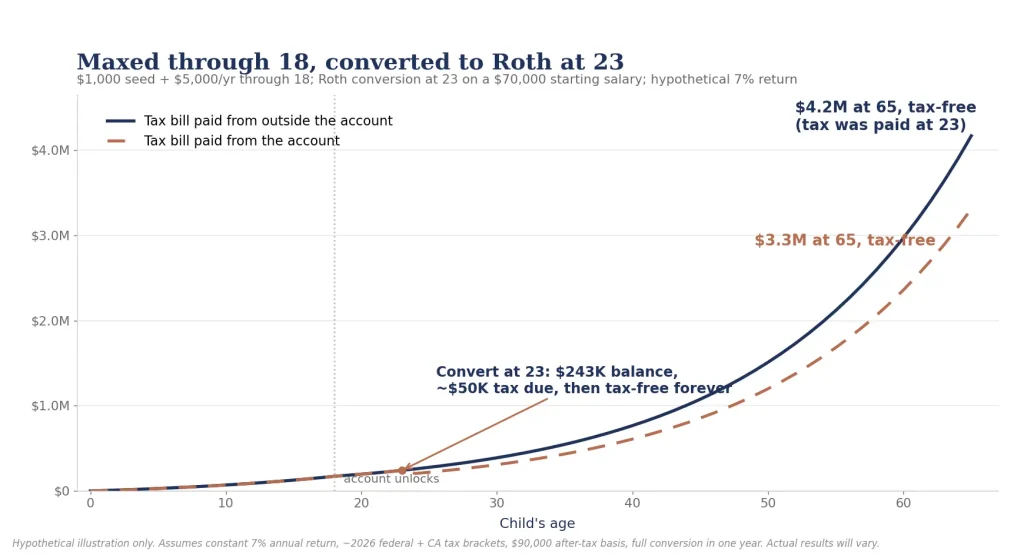
The ceiling, converted to a Roth at 23. The tax is paid once, on about $153,000 of growth, and the account is a Roth from then on. Pay the roughly $50,000 bill from outside the account and the full balance compounds untouched to about $4.2 million, tax free. Make the kid pay it from the account and the endpoint drops to about $3.3 million. An $860,000 gap from a $50,000 decision, which is the whole argument for planning the tax bill in advance.
The honest caveat: locked up money is the most expensive kind for a household without much cash cushion, because a balance you cannot touch until 18 cannot fix a transmission in March. The basics come first: emergency cushion, high interest debt, any employer 401(k) match. But the $1,000 seed sits outside that ordering entirely. It costs nothing, requires nothing, and waits patiently either way.
Final Thoughts
This account is a bet on time, and time takes things out of your hands. The money is your child’s from day one, the control becomes theirs at 18, and the beneficiary can never be changed, so the first thing you are funding is a decision your 18 year old will make without you. Fund choices beyond the default are coming, and financial aid treatment is unsettled. None of that is a reason to stay away. It just means assess annually as you go.
Simply put, take every dollar someone else puts in, and think hard, with a twenty year lens, before adding your own. That is what optionality means. The account does not have to be the best wrapper to be a useful one. It just has to give your kid a door that is open in 2048 that would otherwise be closed.